
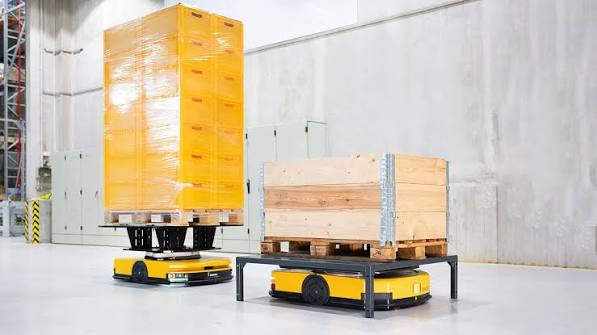
In today’s fast-paced industrial and commercial environments, efficient material handling plays an important role in maintaining productivity, improving workplace safety, and reducing operational costs. Warehouses, distribution centers, manufacturing facilities, and logistics companies depend on reliable equipment to move heavy loads quickly and safely. One solution that supports these operations is the Amr Pallet Mover, a modern material-handling system designed to simplify pallet transportation and improve workflow efficiency.
As businesses continue to adopt automation and smarter warehouse technologies, autonomous material-handling equipment is becoming increasingly valuable. An Amr Pallet Mover can help organizations reduce manual transportation tasks, optimize warehouse operations, and create a more organized working environment. Understanding its features, applications, and benefits can help businesses determine whether this technology is suitable for their material-handling requirements.
What Is an Amr Pallet Mover?
An Amr Pallet Mover is an autonomous mobile robot designed to transport palletized goods from one location to another within a facility. AMR stands for Autonomous Mobile Robot, which means the equipment can navigate its working environment with minimal human intervention.
Unlike traditional pallet trucks that require continuous manual operation, autonomous pallet movers use advanced navigation technologies, sensors, and intelligent control systems to travel along designated routes or dynamically select suitable paths.
These machines are designed to handle repetitive transportation activities, such as moving raw materials to production areas, transferring finished products to storage locations, and delivering pallets to loading or unloading stations.
By automating these tasks, businesses can improve transportation consistency while allowing employees to focus on activities that require human judgment and specialized skills.
How Does an Amr Pallet Mover Work?
The operation of an Amr Pallet Mover involves several integrated technologies that allow it to move materials safely and efficiently.
First, the robot receives a transportation task through a warehouse management system, fleet management software, or operator interface. The system identifies the pickup and delivery locations before assigning the movement task.
The autonomous vehicle then uses navigation technology to understand its surroundings. Depending on its design, this technology may include laser scanners, cameras, sensors, and mapping systems.
Once the destination is identified, the robot calculates an appropriate route and begins transporting the pallet. Its sensors continuously monitor the surrounding environment to detect obstacles, people, and other equipment.
If an unexpected object blocks its path, the robot may slow down, stop, or calculate an alternative route, depending on its capabilities and safety configuration.
After reaching the destination, it positions the pallet at the designated location and completes the assigned transportation task.
Key Features of Modern Amr Pallet Movers
Modern autonomous pallet movers offer several features that support efficient industrial operations.
1. Autonomous Navigation
One of the most important features is autonomous navigation. Advanced sensors and intelligent software allow these machines to move through warehouse environments without depending entirely on fixed pathways.
This flexibility can make them suitable for facilities where layouts change frequently or where different transportation routes are required.
2. Intelligent Obstacle Detection
Safety is an essential consideration in warehouses and manufacturing environments. Amr Pallet Movers can use integrated sensors to identify obstacles and respond to changing surroundings.
This technology helps reduce collision risks when equipment operates near employees, shelving systems, and other vehicles.
3. Automated Pallet Transportation
These machines are specifically designed to simplify pallet movement. Depending on the model, they can collect, lift, transport, and deliver compatible pallet loads.
Automating repetitive transportation activities can reduce the physical workload placed on warehouse employees.
4. Smart Fleet Management
Some autonomous pallet movers can communicate with fleet management software. This allows businesses to coordinate multiple robots, assign transportation tasks, monitor performance, and manage traffic within the facility.
Effective fleet coordination can help reduce unnecessary movement and improve equipment utilization.
5. Rechargeable Battery Systems
Battery-powered operation allows autonomous pallet movers to work without traditional fuel systems. Many models support automatic or scheduled charging, depending on their configuration.
Battery management is important for maintaining reliable performance throughout daily warehouse operations.
Benefits of Using an Amr Pallet Mover
Investing in autonomous material-handling technology can provide several operational advantages.
Improved Warehouse Productivity
Manual pallet transportation often involves repetitive activities that consume valuable employee time. An Amr Pallet Mover can automate many of these movements, allowing workers to concentrate on inventory management, quality control, packaging, and other essential responsibilities.
Automated transportation can also support more consistent material flow between different departments.
Reduced Labor-Related Physical Strain
Moving heavy pallets manually can create physical challenges for warehouse employees. Repeated lifting, pushing, and pulling may contribute to workplace fatigue.
Autonomous pallet movers help reduce the need for employees to perform certain demanding transportation activities. This can support a more comfortable working environment when combined with proper safety procedures.
Better Operational Consistency
Human-operated transportation can vary depending on workload, staffing levels, and operational conditions. Automated systems can perform assigned transportation tasks according to programmed instructions.
This consistency helps businesses establish more predictable material-handling processes.
Optimized Warehouse Space
Modern autonomous robots can operate within organized warehouse layouts and follow optimized routes. Their movement can be coordinated with storage areas, production stations, and loading zones.
Depending on the equipment’s dimensions and navigation capabilities, businesses may be able to improve how available floor space is utilized.
Long-Term Cost Management
Although purchasing autonomous equipment requires an initial investment, businesses may benefit from reduced repetitive labor requirements, improved workflow efficiency, and better transportation planning.
The overall financial value depends on equipment costs, maintenance requirements, utilization rates, labor expenses, and the number of transportation tasks performed daily.
Applications of Amr Pallet Movers Across Different Industries
Amr Pallet Movers can support various industries where pallet transportation is a regular operational requirement.
Warehousing and Distribution
Warehouses frequently move pallets between receiving areas, storage locations, picking stations, and dispatch zones. Autonomous pallet movers can help automate these repetitive movements and support faster order-processing operations.
Manufacturing Facilities
Manufacturing businesses depend on reliable material delivery to maintain production schedules. Autonomous pallet movers can transport components, packaging materials, and finished products between different production areas.
This helps establish a more organized material supply process.
Food and Beverage Industry
Food and beverage facilities often handle large quantities of packaged products, ingredients, and finished goods. Autonomous transportation equipment can support internal material movement in suitable environments.
Businesses must select equipment designed for their specific hygiene, temperature, and operational requirements.
Pharmaceutical and Healthcare Logistics
Pharmaceutical warehouses require careful inventory management and controlled transportation processes. Autonomous pallet movers can support the movement of packaged supplies and other compatible palletized materials.
Their integration with inventory systems may also improve transportation tracking and workflow coordination.
Retail and E-Commerce
Retail distribution centers manage large product volumes and frequent order shipments. Autonomous pallet movers can help transfer inventory between storage, sorting, packaging, and dispatch areas.
This can be particularly useful for facilities that experience changing order volumes throughout the year.
Amr Pallet Mover vs. Traditional Pallet Trucks
Traditional pallet trucks remain useful for many material-handling applications because they are generally simple to operate and suitable for smaller transportation requirements.
However, autonomous pallet movers offer additional capabilities that can make them attractive for businesses with repetitive and high-volume transportation needs.
Traditional pallet trucks normally require an employee to control their movement. In comparison, autonomous pallet movers can complete assigned transportation tasks using navigation software and onboard sensors.
Another difference is task coordination. Traditional equipment depends heavily on manual communication, while connected autonomous systems may receive instructions through integrated warehouse software.
Nevertheless, both options have their advantages. Smaller facilities with occasional pallet movements may find traditional equipment more practical, while larger operations with predictable transportation requirements may benefit from automation.
Important Factors to Consider Before Choosing an Amr Pallet Mover
Selecting the right equipment requires an understanding of the facility’s operational needs.
Load Capacity: Businesses should determine the maximum pallet weight the equipment must transport. Selecting an appropriate capacity helps ensure reliable and safe operation.
Pallet Compatibility: Not every pallet mover supports every pallet type. Check pallet dimensions, entry requirements, lifting mechanisms, and load configurations before purchasing.
Navigation Technology: Evaluate whether the equipment can navigate the facility’s layout, detect obstacles, and operate effectively around employees and other vehicles.
Battery Performance: Consider battery capacity, charging time, operating duration, and charging infrastructure.
Software Integration: Compatibility with existing warehouse management and enterprise resource planning systems can improve task coordination.
Maintenance and Support: Reliable technical support, replacement parts, software updates, and maintenance services are important for long-term performance.
The Future of Autonomous Pallet Transportation
Warehouse automation is expected to remain an important part of industrial development. As artificial intelligence, sensor technology, and robotics continue to improve, autonomous pallet movers may become more capable of handling complex transportation requirements.
Future developments could include improved navigation accuracy, more advanced fleet coordination, better energy management, and deeper integration with warehouse management platforms.
Businesses may also use operational data from autonomous equipment to identify transportation bottlenecks, improve scheduling, and make better decisions about facility layouts.
These developments highlight the growing importance of intelligent material-handling solutions in modern supply chains.
Conclusion
An Amr Pallet Mover offers a modern approach to pallet transportation by combining autonomous navigation, intelligent sensors, and automated material handling. From warehouses and manufacturing facilities to retail distribution centers, this technology can help businesses improve productivity, reduce repetitive manual work, and establish more organized transportation processes.
Choosing the right equipment requires careful consideration of load capacity, pallet compatibility, navigation capabilities, battery performance, and software integration. When properly selected and implemented, an autonomous pallet mover can become a valuable part of a company’s material-handling strategy.
As businesses continue to explore automation, Amr Pallet Movers represent an important step toward safer, smarter, and more efficient warehouse operations.